Where do we go from here?
On the afternoon of October 14, I was scheduled to give my final lecture in the course Digital Marketing and Social Media at Jönköping School of Engineering. The title was “Where do we go from here?”

It was meant to be a lecture about the future of digital marketing and the broken marketplace we call the Internet. It was a lecture I never gave, because that same afternoon, my beloved Martin passed away.
So, where do we go from here?
I have asked myself that question so many times since. Does it mean the same thing in marketing as it does in life? Perhaps. Because in both, the challenge is to keep moving. With reason, with care, and with attention to what is real and lasting.
This is the text I had planned to teach around on October 14. It begins here. It is the final part in a series of seven lectures that together form my course Digital Marketing and Social Media at the School of Engineering, Jönköping University.
Over the past months, we have explored the field of Digital Marketing and Social Media. We have seen that Digital Marketing is not just as a set of tools, but should be seen as a human system. We looked beneath the shiny surface of platforms and trends to uncover the fundamental limits that shape how we think, learn, and communicate.
We discovered that the noisy, constantly optimizing environment of modern digital advertising functions as a broken marketplace; overwhelming the consumer and eroding the value of communication itself. We learned that the chase to be merely different is futile; enduring success comes from being distinctive, creating a clear, recognizable signal that cuts through the noise.
So, how do we build systems and content strategies that genuinely respect the finite capacity of the human mind, ensuring our message is not only seen, but understood and remembered?
Two theories can guide us here:
One describes the limits inside us: Cognitive Load Theory (Sweller, 1988).
The other explains the limits around us: Information Theory (Shannon, 1948).
Sweller (1988): Respecting limited bandwidth
John Sweller’s work on Cognitive Load Theory reminds us that the human working memory, the part of the brain actively processing information, has limited capacity. When people are forced to engage in complex, goal-driven problem solving (what Sweller calls means-ends analysis), they consume much of that capacity just figuring out what to do next.
The practical problem:
If your website, ad, or message forces the user to stop and think about how to proceed or why something matters, their limited mental bandwidth is spent on navigation instead of understanding. What’s lost is schema acquisition — the process of learning and storing meaningful knowledge about your brand, product, or message.
The hands-on solution:
Simplify. Sweller showed that when learners are freed from specific, high-stakes goals and instead encouraged to explore or understand patterns (goal-free design), cognitive load drops dramatically. The mind shifts from “How do I get there?” to “What is this structure?” This is a state far more conducive to learning.
Your marketing takeaway:
Your customer’s brain shouldn’t have to work to understand your ad. It should have room to absorb it. Design for minimal cognitive load. Keep pathways intuitive, visuals consistent, and complexity low, freeing up mental capacity for the one thing that matters: your core message.
Shannon (1948): Building messages that survive noise
While Sweller helps us design for the human mind, Shannon helps us design for the world it lives in. A world full of noise.
The practical problem:
Digital channels are inherently noisy: endless notifications, competing messages, shifting algorithms. When the channel is unstable, even a small distraction can make an entire message disappear.
The hands-on solution:
Embrace redundancy. Shannon proved that information sent through a noisy channel must be repeated or structured redundantly to survive interference. Redundancy isn’t waste; it’s protection. It ensures that even if part of the message is lost, the whole can still be reconstructed.
Your marketing takeaway:
Distinctiveness is applied redundancy. The repetition of core elements ensure recognition and stability. In a noisy environment, sameness is not a weakness; it is strength. The goal is not to say more, but to say what matters, again and again, until it cuts through.
The future of expertise
In the end, this is not just about marketing efficiency. It’s about designing systems that work with the human brain rather than against it.
Neil Postman once warned that if we fail to understand technology, we risk being used by it rather than using it. Expertise, in any field, is built from deep, organized knowledge. Schemas free us from cognitive overload, allowing space for higher-order thinking, creativity, and ethics.
When we design marketing that respects human cognition, we give people the mental room to understand, reflect, and respond, instead of just reacting. That’s not only good communication. It’s a way of staying human in a system that often forgets what being human means.
So. Where do we go from here?
We can study cognition, design better systems, and communicate more wisely. But in the end, the question remains the same, whether in marketing or in life: how do we move forward when so much is uncertain?
All of this brings us back to where we began. Understanding how minds work, how meaning is built and preserved, is not only a scientific pursuit. It is an attempt to find orientation in noise, to create a bit of order in the overwhelming stream of signals around us. And that search, at its core, is not so different from the one we face in life itself. How do we keep moving, even when the path ahead is unclear?
We try to make sense of complexity, in systems, in markets, and in ourselves. We look for structure, for clarity, for meaning that lasts. But beneath it all lies the same question that started this lecture, and this loss: how do we keep going, when everything keeps changing?
I suppose there is only one way forward - in marketing, and in life. To put one foot in front of the other, one step at a time, and keep going even when we don’t know exactly where the path will lead.
Either we frame it as Karl Popper did:
“We must go on into the unknown, the uncertain and insecure, using what reason we may have to plan as well as we can for both security and freedom.”
(Karl Popper, The Open Society)
Or we frame it the way Mark Knopfler does:
There’s just a song in all the trouble and the strife.
You do the walk.
Yeah.
You do the walk of life.
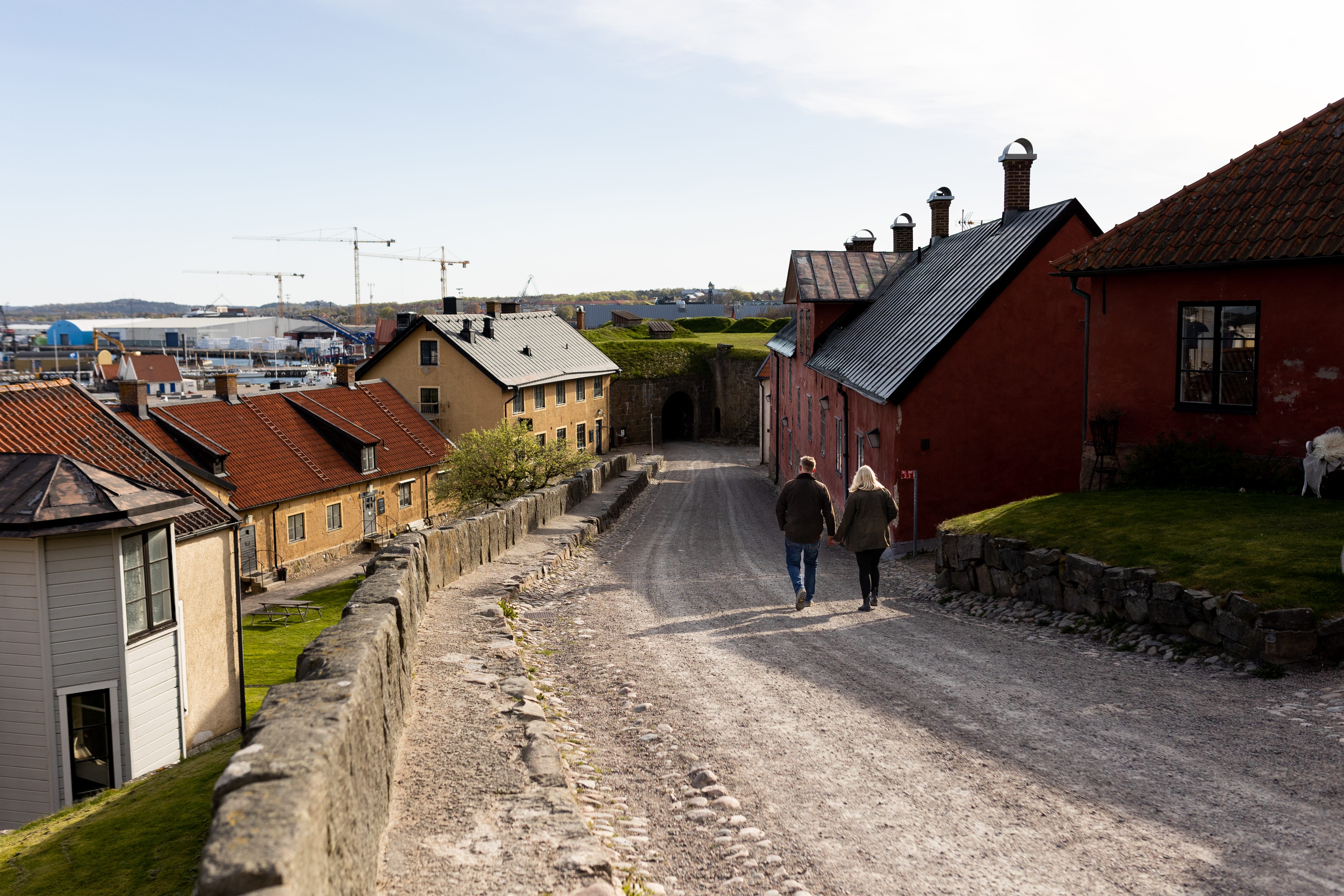
Photo: K Marøy, spring 2023