What every university web manager should know in 2025
In 2025, the way to gain more students is simple: make each of your landing pages do one job, open with a two-sentence answer, and keep dates, fees, and steps identical everywhere.

This article is primarily for my Digital Marketing and Social Media students at Jönköping University, but can be useful to anyone who wants a guide to what actually matters when building websites in 2025.
Generative Engine optimisation (GEO) didn’t replace Search Engine Optimisation (SEO); it exposed your structure. That means if your pages are clear, consistent, and built around one job, AI assistants (such as ChatGPT) can quote you. If they’re messy, your different pages saying different things, long waffle, unclear labels; you won’t get cited, and students won’t find what they need.
In this article, I look at what GEO means for building websites, using a university site as the running example. At times it gets a bit tech-nerdy, but stick with me; I translate the jargon and give copy-paste snippets you can use right away.
From a search centric to an assistant centric web
Future and current students, employers, and other stakeholders used to scan a search engine results page (SERP) and out of the ten blue links pick the link that looked most likely to answer their question or meet their need. Now we often ask an assistant (like ChatGPT). It writes a short answer first and shows sources after. If your page isn’t clear enough to quote, it won’t show up.
That means we have to build our university webpages differently. A page can’t just be nice text; it has to be organised data too. Assistants pull out clearly labelled facts, simple step lists, and short definitions from obvious places (headings, small tables, brief summaries). They reward:
Consistency: same words and numbers everywhere.
Clarity: a two-sentence answer at the top.
Focus: one job per page with a clear next step.
In practice: a facts-at-a-glance box, a few plain-language FAQs, and one main page per topic that related pages link to.
What SEO is (and why it still matters)
SEO makes your content findable and chosen in organic search. You align with a real job to be done, keep pages fast and crawlable, and earn trust so your result wins the click. None of that is optional.
What GEO is (and why it’s new)
Generative Engine Optimization makes your content quotable and citable in AI answers (Google’s AI Overviews, Bing/Copilot, Perplexity, ChatGPT browsing). These systems synthesize an answer first, then attribute sources. If you are not structured, consistent, and unambiguous, you don’t get cited.
What changed vs. what didn’t
What changed
Many tools now show the answer first. Think “model answer, then bibliography.” machines also treat pages as data. they lift facts from clear headings, tables, and labeled blocks, and they ignore long, decorative prose. and the competition changed: it’s no longer only “be the first blue link,” it’s “be quoted in the answer box.”
What didn’t change
Intent still rules. If a page doesn’t help someone do their job (that is; if you run a university webpage: apply, register, find fees), it won’t be selected.
Hygiene still wins: pages must load quickly, respond immediately, and stay stable on the screen, with clean internal links and one official version of each page.
Authority still counts: reputable sites should mention and link to you, and your names, addresses, and profiles must be consistent everywhere.
Turn pages into answers (so humans and engines can lift them)
Imagine I run a university website. My job is to turn every page into an answer—something a person (and an AI) can lift in seconds. Step one is to name the job to be done for this page.
For a university site, one core job is clear: help prospective students apply for a master’s programme. To deliver that, I need one definitive landing page. It should:
1. Open with a two-sentence answer at the top
Example: “Scholarship X is a yearly grant for full-time master’s students. It covers tuition only and requires a 3.5 GPA.”
Steps: “Apply in three steps: 1) check eligibility, 2) upload transcripts, 3) submit before 1 May.”
2. Put the primary action front and center
Example (CTA just below the answer block):
Apply now — applications close 15 January 2026
Secondary links: Check eligibility · Tuition & scholarships · Key dates
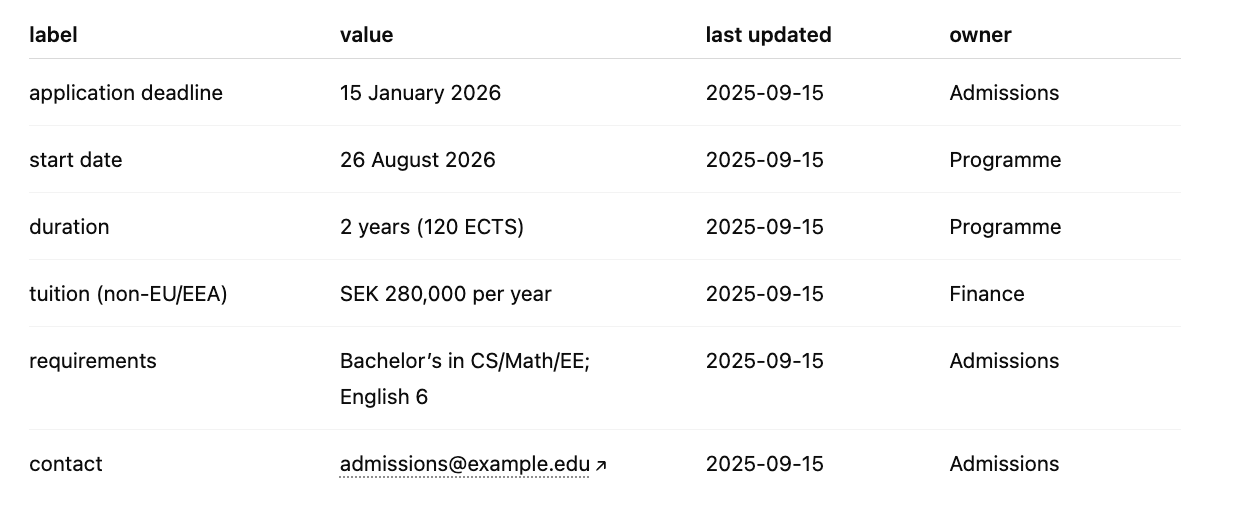
3. Put volatile facts in a mini table
Columns: label | value | last updated | owner. Facts: dates, fees, capacities, requirements, contacts. Keep labels consistent.
4. Add real FAQs that mirror queries
3–6 questions; answers ≤80 words; write them the way people ask; no jargon.
Example FAQs (≤80 words each, plain language):
How do I apply?
Create an account in our application portal, select “MSc in Data Science,” upload transcripts and proof of English (level 6), add your CV and statement of purpose, and submit by 15 January 2026. You’ll receive a confirmation email immediately.
What are the entry requirements?
A bachelor’s in computer science, mathematics, or electrical engineering (or closely related), plus English 6 (or equivalent). Strong programming skills are expected. No GRE/GMAT required.
What does it cost?
For non-EU/EEA applicants: SEK 280,000 per year. EU/EEA applicants currently pay no tuition. Everyone pays a small application fee unless exempt. See “Tuition & scholarships.”
Are scholarships available?
Yes—merit-based tuition scholarships. You apply after submitting your programme application. Awards cover part or all tuition; living expenses are not included.
Can I apply with a business degree?
Yes, if you can demonstrate equivalent maths and programming (courses or experience). Use “Check eligibility” to see accepted equivalents.
5. Mark up with schema*
*If you are not the tech department, skip this chapter. My point is that this is important, if you want to recruit students in 2025.
Use the right type: Article, HowTo, FAQPage, Product, Course, Organization, LocalBusiness, BreadcrumbList. Include name, description, dateModified; add offers/steps/acceptedAnswer where relevant; use sameAs to authoritative profiles.
Example JSON-LD (minimal, aligned with the same facts):
<script type="application/ld+json">
{
  "@context": "https://schema.org",
  "@graph": [
    {
      "@type": "Course",
      "name": "MSc in Data Science",
      "description": "Two-year full-time master's programme in machine learning and analytics.",
      "provider": {
        "@type": "CollegeOrUniversity",
        "name": "Example University",
        "sameAs": ["https://www.wikidata.org/wiki/QXXXX"]
      },
      "url": "https://www.example.edu/programmes/msc-data-science",
      "dateModified": "2025-09-15",
      "hasCourseInstance": [{
        "@type": "CourseInstance",
        "name": "Autumn 2026 intake",
        "courseMode": "Full-time",
        "startDate": "2026-08-26",
        "endDate": "2028-06-10",
        "location": {"@type": "Place","name": "Campus City"}
      }]
    },
    {
      "@type": "HowTo",
      "name": "Apply for the MSc in Data Science",
      "step": [
        {"@type": "HowToStep","name": "Check eligibility"},
        {"@type": "HowToStep","name": "Prepare documents"},
        {"@type": "HowToStep","name": "Submit by 15 January 2026"}
      ],
      "totalTime": "P30D",
      "url": "https://www.example.edu/programmes/msc-data-science/apply"
    },
    {
      "@type": "FAQPage",
      "mainEntity": [
        {
          "@type": "Question",
          "name": "How do I apply?",
          "acceptedAnswer": {"@type":"Answer","text":"Create an account in our portal, select “MSc in Data Science,” upload required documents, and submit by 15 January 2026."}
        },
        {
          "@type": "Question",
          "name": "What are the entry requirements?",
          "acceptedAnswer": {"@type":"Answer","text":"Bachelor’s in CS/Math/EE (or related) and English 6. No GRE/GMAT required."}
        }
      ]
    }
  ]
}
</script>
6. Declare the entity clearly on-page.
A canonical page is the one official URL you choose as the source for a topic, and you point any duplicates or variations to it (using rel="canonical") so search engines treat that page as the original. One canonical page per concept; link to it with descriptive anchors (e.g., “tuition fees,” “application deadline”).
Example (on the page itself):
Official name: MSc in Data Science
Also called: Master of Science in Data Science; MSc Data Science
This is the canonical page for the MSc in Data Science.
Use descriptive links back to this page: tuition fees, application deadline, entry requirements.
7. Make internal links intentional.
Every important concept has one home page; use anchors that name the concept.
Example internal link map (anchor → canonical URL):
Tuition & scholarships → /programmes/msc-data-science/tuition-scholarships
Entry requirements → /programmes/msc-data-science/requirements
Application deadline → /programmes/msc-data-science/apply#dates
Programme overview → /programmes/msc-data-science (this page)
Contact admissions → /admissions/contact
Each supporting page links back to the overview with descriptive anchors (not “click here”).
8. Write for scanning.
H1 = page job; H2 = big chunks; H3 = details. Titles ~40–60 chars; metas ~140–160 and echo the answer block.
Example structure:
H1: Apply for the MSc in Data Science
Intro block (two sentences): as in section 1
H2: Check eligibility (H3: required background; H3: English level)
H2: How to apply (H3: documents; H3: deadlines)
H2: Tuition and scholarships
H2: Key dates (facts table)
H2: FAQs
Example title & meta:
Title (≈55 chars): Apply for MSc in Data Science | Example University
Meta description (≈150 chars): Apply to the two-year MSc in Data Science. Check eligibility, tuition, deadlines, and submit your application by 15 January 2026.
Rule of thumb
Two verbs? Split it.
Label needs explaining? Rewrite it.
No answer in 10 seconds at the top? Add a two-sentence summary and push details down.a worked example (before → after)
before
“Our program offers a rich, future-oriented experience drawing on interdisciplinary excellence. Applications are processed on a rolling basis and we welcome diverse backgrounds.”
after
answer block
“The MSc in Data Science is a two-year, full-time program focused on machine learning and analytics. Admission requires a bachelor’s in CS/Math/EE and proof of English proficiency.”
Nothing changes for people; they read the page as usual. The schema just adds clear labels for machines, so search engines and AI can tell what it is (“Course”) and when a specific run happens (“CourseInstance”), avoiding mix-ups between the programme length and the start/end dates.
Operational changes (the real unlock)
Here are some quick, concrete upgrades you can ship in 30 minutes to make a page GEO-ready.
Single source of truth for facts
Keep a shared sheet or CMS fields for volatile facts (labels, values, owner, review date). Push those fields into pages and schema.
Entity map
List your core entities (organization, schools, programs, services, locations). One canonical URL each, with sameAs links. Audit quarterly.
Content patterns library
Templates for: definition block, steps block, facts table, FAQ, schema snippets, internal link map. Reuse everywhere.
Publishing rules
No new page without: H1 that states the job, answer block, facts table (if relevant), internal links to parent/siblings, last updated date.
Two checks before publish
Before publishing, ask yourself:
Will this help a student finish a task faster? If not, cut or move it.
Is every fact (date/fee) identical across pages? If not, fix the outlier.
Quick GEO playbook
Pick one audience + one job to be done.
Identify the one landing page that should answer it.
Add the answer block, facts table, FAQ, and schema.
Fix internal links so all related pages point to this canonical page with descriptive anchors.
Test in three engines (AI Overview, Perplexity, Copilot). Screenshot citations.
If absent, compare your page to cited competitors: is their answer block tighter? Do they use schema? Are their facts clearer? Adjust and retest.
Bottom line
GEO didn’t replace SEO; it exposed your structure. When you reduce friction and present stable facts the same way every time, models can quote you and people can act. Working memory is small. Build like you respect it—and you’ll rank, get cited, and get chosen.