#18. Embedded in every technology there is a powerful idea.
Window 18 stems directly from Neil Postman's original speech "Five things we need to know about technological change."

Embedded in every technology is a powerful idea about how the world should work.
We often talk about technologies as neutral tools. Platforms. Systems. Infrastructure. But technologies are never just containers. They carry assumptions about behaviour, value, and organisation, whether we notice them or not.
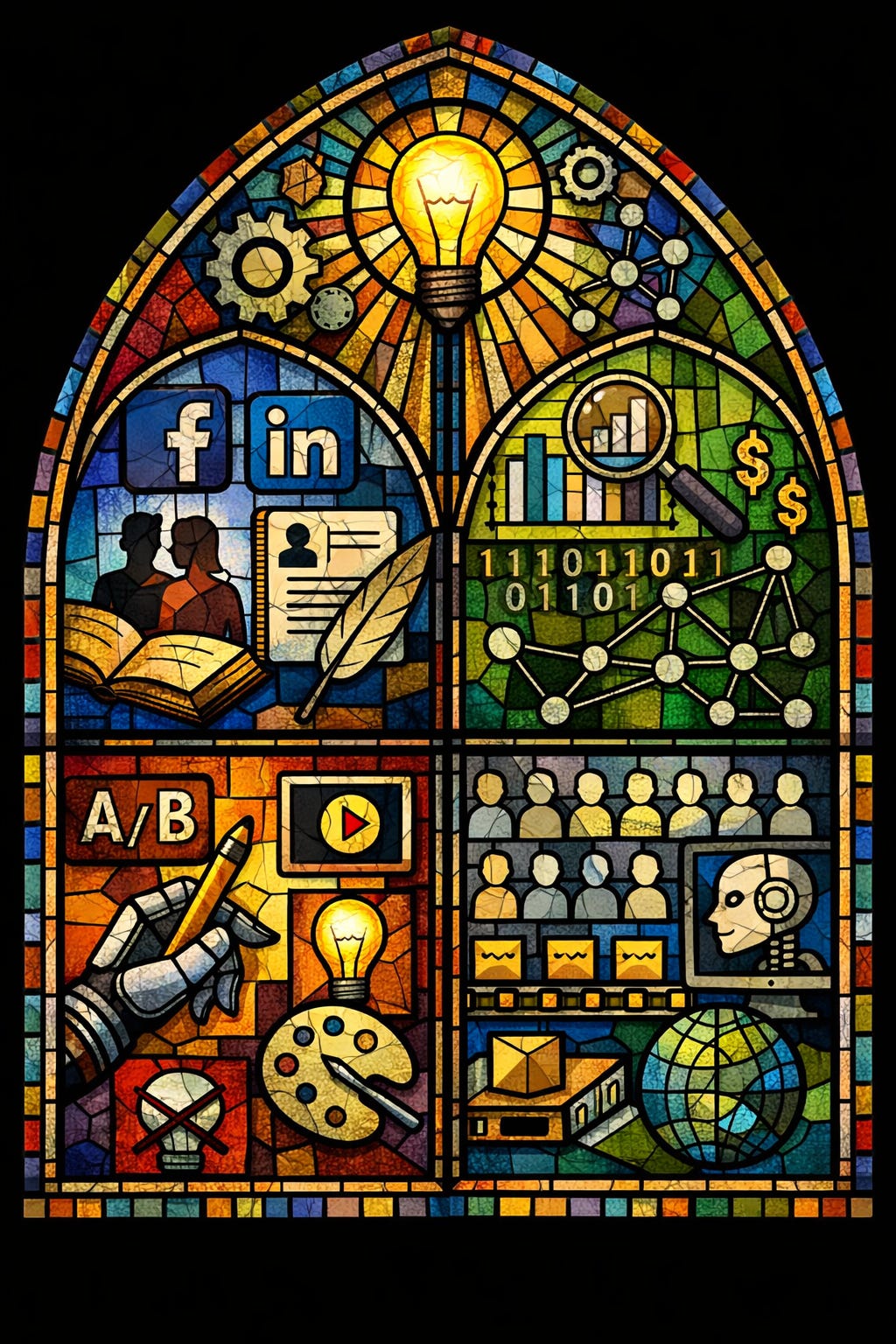
Facebook did not start as a place for political debate or global news. It started as a dating and ranking site. LinkedIn began as a digital CV repository. Those origins matter, because early ideas tend to linger. What begins as connection often turns into comparison. What begins as professional documentation becomes performance.
Older technologies show this even more clearly. The printing press did not simply add written text to the world. It reshaped what counted as knowledge. Oral traditions lost status. Memory and storytelling were devalued in favour of permanence, authorship, and linear argument. A technology that privileged print also privileged certain ways of thinking.
The same thing happens today.
Algorithms shape creativity by rewarding what can be measured, tested, and optimised. Designers and marketers are nudged toward formats that perform well within platform logic. Shorter. Faster. Clearer. Less ambiguous. Open-ended or experimental ideas struggle because they resist optimisation.
Relationships are reshaped too. When customers are primarily understood through data traces, interactions become transactional. Clicks replace conversations. Metrics stand in for meaning. What is easy to measure starts to matter more than what is difficult to understand.
And then there is homogenisation. Automated design tools and generative systems make production efficient, but they also pull outputs toward what already works. Scale rewards sameness. Distinction becomes riskier. Variation becomes costly.
This is not a moral argument against technology. It is an analytical one.
Window #18 is a reminder that technologies do not just help us do things. They quietly teach us how to think, what to value, and which actions make sense. If we want to understand technological change, we need to look beyond functionality and pay attention to the ideas built into the tools we use every day.